


Technology
Technology used in PNOY's Ionizers
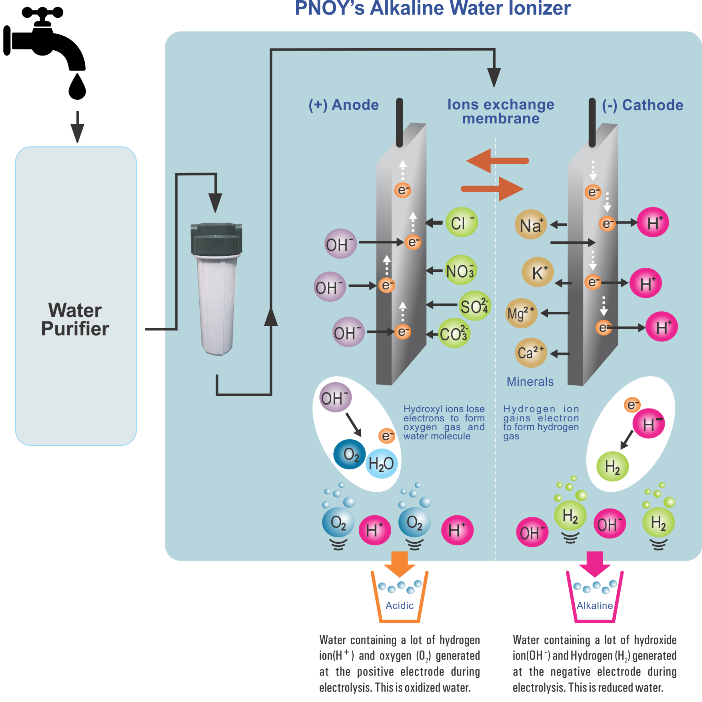
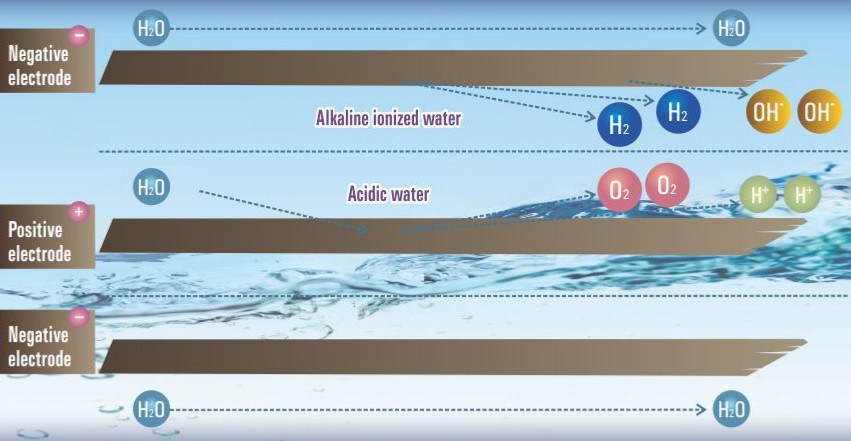
The basic principle of electrolysis of water has been used in the technology of PNOY's Ionizers. In general, water cannot decompose into O2 and H2 in its natural state. However, by applying Faraday's Law of Electrolysis, which involves adding a cathode and anode into the water and passing a current across it, the water is electrolyzed to separate the hydrogen (H+) ion and the hydroxide (OH-) ion. This electrolysis process is performed in an electrolysis chamber equipped with platinum-coated titanium electrodes and a semi-permeable ion exchange membrane. This membrane prevents the catholyte (with the alkaline OH ion) and analyte (with the acidic H+ ions) compartments from getting mixed. Thus, alkaline (mild or strong) and acidic (mild or strong) water is produced at the cathode and anode, respectively. Oxidation-reduction reactions occur at the cathode (negative electrode) and anode (positive electrode), and H2 and O2 are produced at the surface of the cathode and anode. The water around the electrodes becomes alkaline and acidic, and the oxidation-reduction potential (ORP) of the water also changes. The acidic (oxidized) water with a high concentration of hydrogen ions is collected from the positive pole, while the alkaline (reduced) water is collected from the negative pole. Through electrolysis, alkaline water not only gains an excess amount of electrons but also the clusters of water seem to be reduced in size. This reduced water is dispensed from the main faucet, while the oxidized water is dispensed from a separate hose.
The electrolyzer at the heart of the alkaline Ionized water generation process features high-performance pure titanium electrodes with a platinum coating that is very resistant to deterioration. Catalyzing the electrolysis in water Ionizers is absolutely essential. No titanium alloy is used in PNOY's Ionizers.
How is Alkaline Ionized Water Generated?
The quality of water we drink determines the quality of our health. To keep us healthy, our bodies maintain just the right internal conditions such as the concentration of electrolytes, body temperature, and pH. Our body contains a lot of water—around 60% of an adult's body weight is body fluid. The water we drink is absorbed by the intestine and circulated throughout the body in the form of body fluid such as blood. A total of about 7200L of blood per day circulates around the body, carrying oxygen, carbon dioxide, nutrients, and metabolic waste. Blood also eliminates bacteria and other foreign materials from our body, so it plays a very important role in keeping us alive. Body fluid contains electrolytes that have a vital role. If electrolyte levels are too low or too high, cell and organ functions will decline, which could lead to life-threatening conditions. These electrolytes include Sodium (Na), Potassium (K), Calcium (Ca), Magnesium (Mg), and Chlorides, and they are absorbed by the water we drink, which maintains the function of muscles and nerve cells. Therefore, an adequate supply of clean and mineral-rich high-quality drinking water is the key to a healthy body.